Exhibition of the Facsimile Specimens of Prints from the Earliest Printing House in Bohemia.
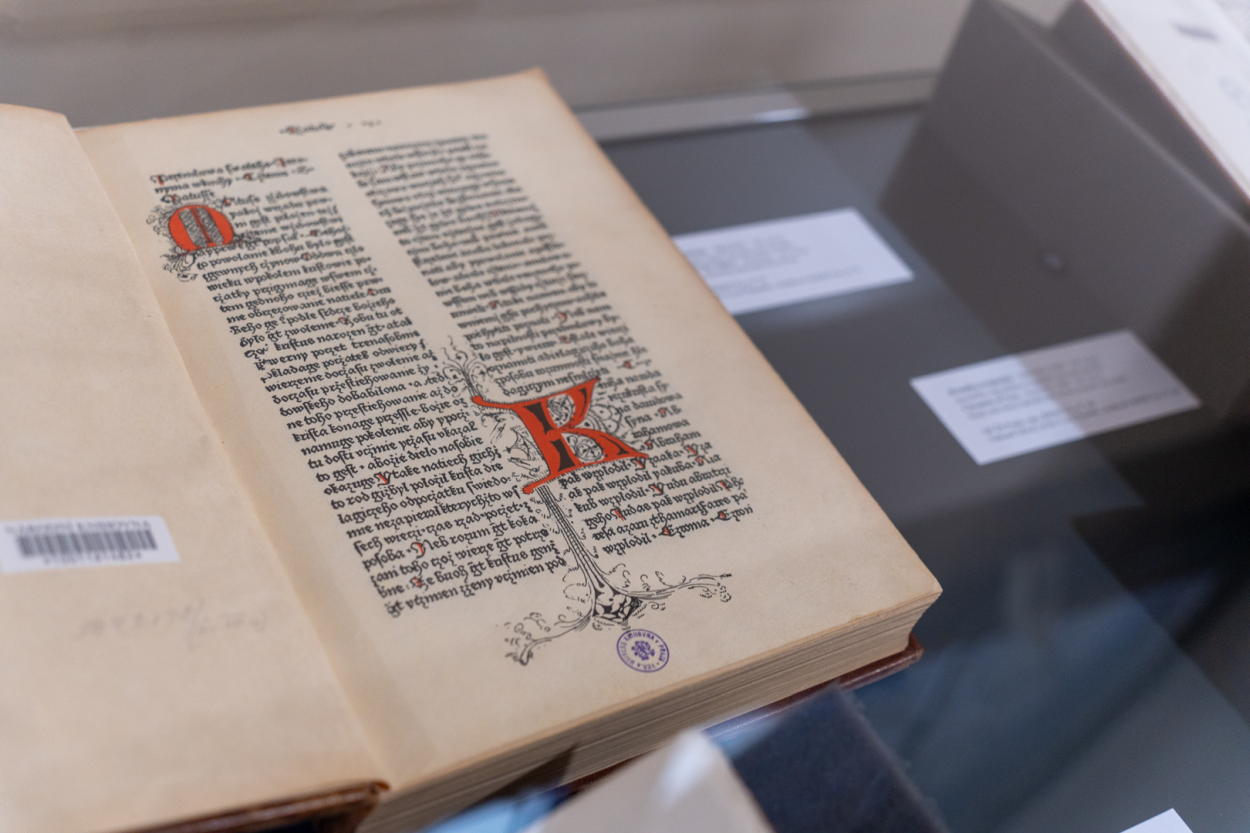
The Plzeň incunabula have always attracted considerable scholarly attention. This is attested not only by the number of specialist studies published on them, but also by the facsimiles exhibited here – that is, modern copies reproducing the originals with the greatest possible fidelity. These were produced for the Prague Missal, the New Testament with the Signet, and, of course, the Chronicle of Troy. The last-named work was in fact copied twice. Its 1918 facsimile is chronologically the earliest item in the group mentioned above. The principal initiator of its production was the librarian Antonín Dolenský. On the occasion of the supposed 450th anniversary of the printing of the Chronicle of Troy, then regarded as the oldest printed book in Bohemia, he approached the Association of Printing-House and Type-Foundry Foremen in Bohemia and the Prague printing house Politika. The exceptional character of their facsimile lay in the fact that it was not produced by the photomechanical methods commonly used at the time; instead, historical typographical techniques were imitated in its preparation. The type was newly redrawn by Rudolf Samec and engraved by Václav Hanzelín. The replica period binding of the facsimile was designed by Ludvík Bradáč. In all, 200 numbered and 10 unnumbered copies were printed. The production process was also distinctive in that it began while the Austro-Hungarian Empire still existed and was completed only after the establishment of the independent Czechoslovak Republic.
In interwar Czechoslovakia, the bibliologist Zdeněk Václav Tobolka continued the production of facsimiles. He was the principal originator of the editorial series Monumenta Bohemiae
typographica. Between 1926 and 1932, he published within this series a total of eleven photomechanical copies of Bohemical incunabula and early sixteenth-century printed books preserved either as unique copies difficult to access or as defective exemplars. As volumes 8 and 9 of this select edition, Tobolka included facsimiles of the New Testament with the Signet (1930) and the Prague Missal (1931). To both copies he added an accompanying bilingual Czech-English booklet, in which he summarised the basic information about the titles in question and their contents.
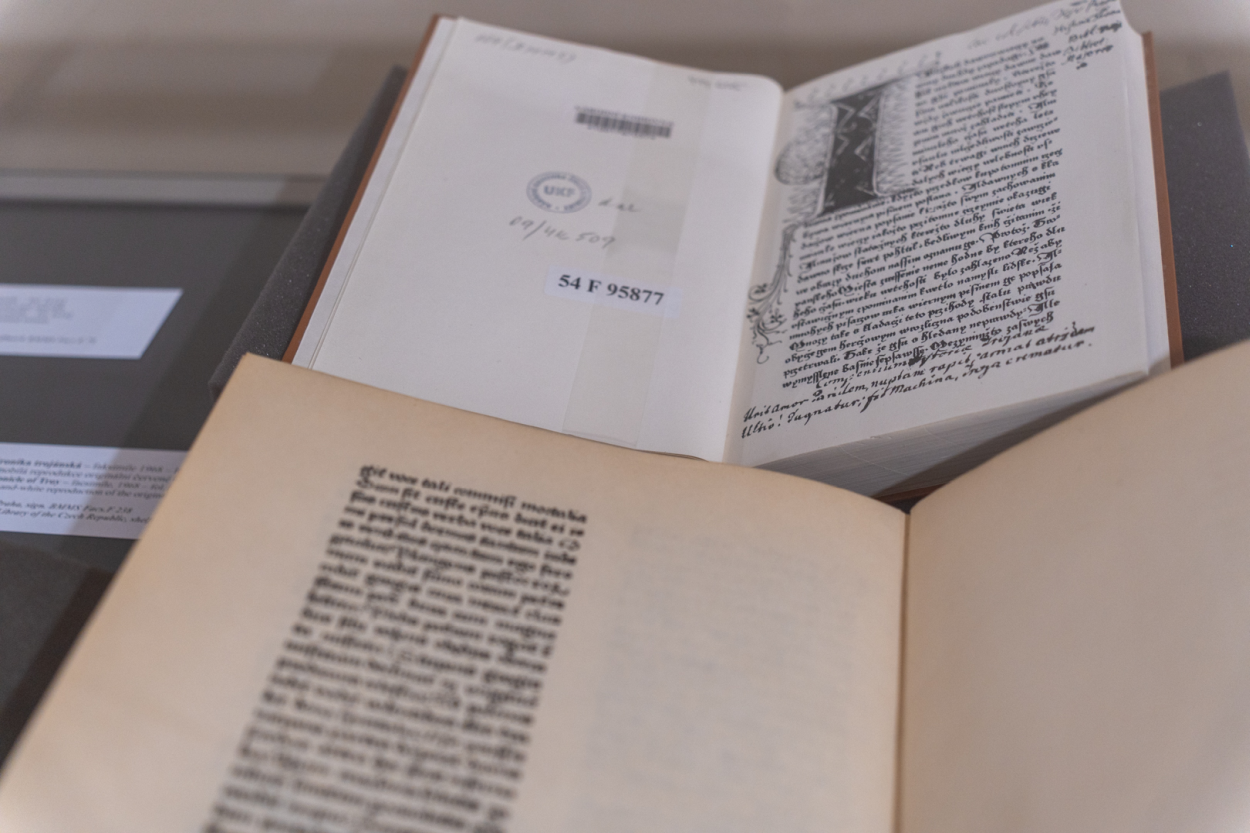
In socialist Czechoslovakia, Tobolka’s activities were continued by the editorial series Cimelia Bohemica, prepared in cooperation between the then State Library of the Czech Socialist Republic and the publishing house Pragopress. Its aim was likewise to publish photomechanical facsimiles of rare book documents. The editorial programme of this series, however, was considerably broader than Tobolka’s. Under its auspices, between 1967 and 1972, copies of early printed books were produced alongside imitations of manuscripts and university theses. Among the incunabula, only the Chronicle of Troy was selected. Its facsimile was produced as volume 4 for the jubilee year 1968. The accompanying commentary was written by the librarian Emma Urbánková. Paradoxically, however, in her commentary she scholarly refuted the association of the Chronicle of Troy with the year 1468.
Exhibits:
Prague Missal – facsimile – fol. [265b], reproduction of the final explicit, exceptionally giving the date of printing (19 November 1479) – National Library of the Czech Republic, Prague, shelfmark BMMS Facs E 80
New Testament with the Signet – facsimile – fol. [a1a], opening of the book, imitating hand-painted initials – National Library of the Czech Republic, Prague, shelfmark BMMS Facs E 79
Chronicle of Troy – facsimile, 1918 – fol. [d4b], copy of what was originally the only printed initial in the entire book – National Library of the Czech Republic, Prague, shelfmark BMMS Facs F 78
Chronicle of Troy – facsimile, 1968 – fol. [a1a], black-and-white reproduction of the original red initial – National Library of the Czech Republic, Prague, shelfmark BMMS Facs.F 238