The Jesuit Printing House in Prague operated under the administration of the Society of Jesus and the university for nearly 140 years.
The Jesuit Printing House in Prague (1635–1773)
During the period 1635–1773 it produced more than 3,300 publications, placing it at the forefront of all Czech printing establishments of the seventeenth and eighteenth centuries. Among its learned superiors were figures such as Jiří František Plachý and Bedřich Bridel; and among its secular factors we find the prominent printers Jiří Černoch and Vojtěch Jiří Koniáš. For most of its existence, the printing house was located in Clementinum, and its presses yielded many treasures of Baroque literature.
Prints from the Jesuit Printing House in Prague (1635–1773)
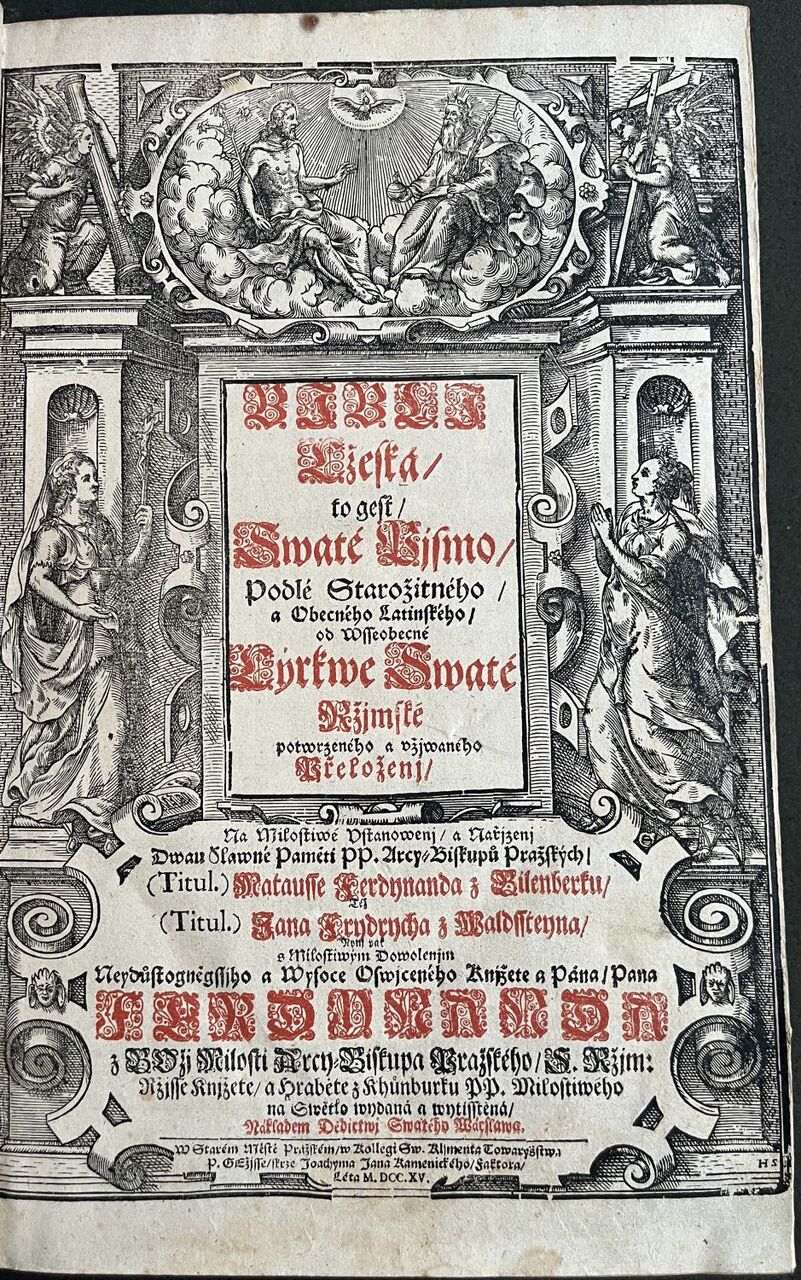
The first complete Czech Catholic Bible, known as the St Wenceslas Bible, was published by the Jesuit Printing House in the years 1677 (New Testament), 1712 (Prophets), and 1715 (Old Testament). It employs the cycle of illustrations from the fourth edition of Melantrich’s Bible of 1570, which the Jesuits purchased in 1646. In the Old Testament, we see the original title page; however, instead of Jiří Melantrich of Aventinum kneeling before the cross, the lower volute frame bears the privilege and imprint “in the College of St Clement of the Society of Jesus.” The printing of the Bible was commissioned to the Jesuit Printing House by the publishing house Dědictví svatého Václava (“The Heritage of St Wenceslas”), founded by the Prague baker Marie Štajerová and her son Matěj Václav Štajer, a Jesuit preacher and writer.
NL CR 54 A 12
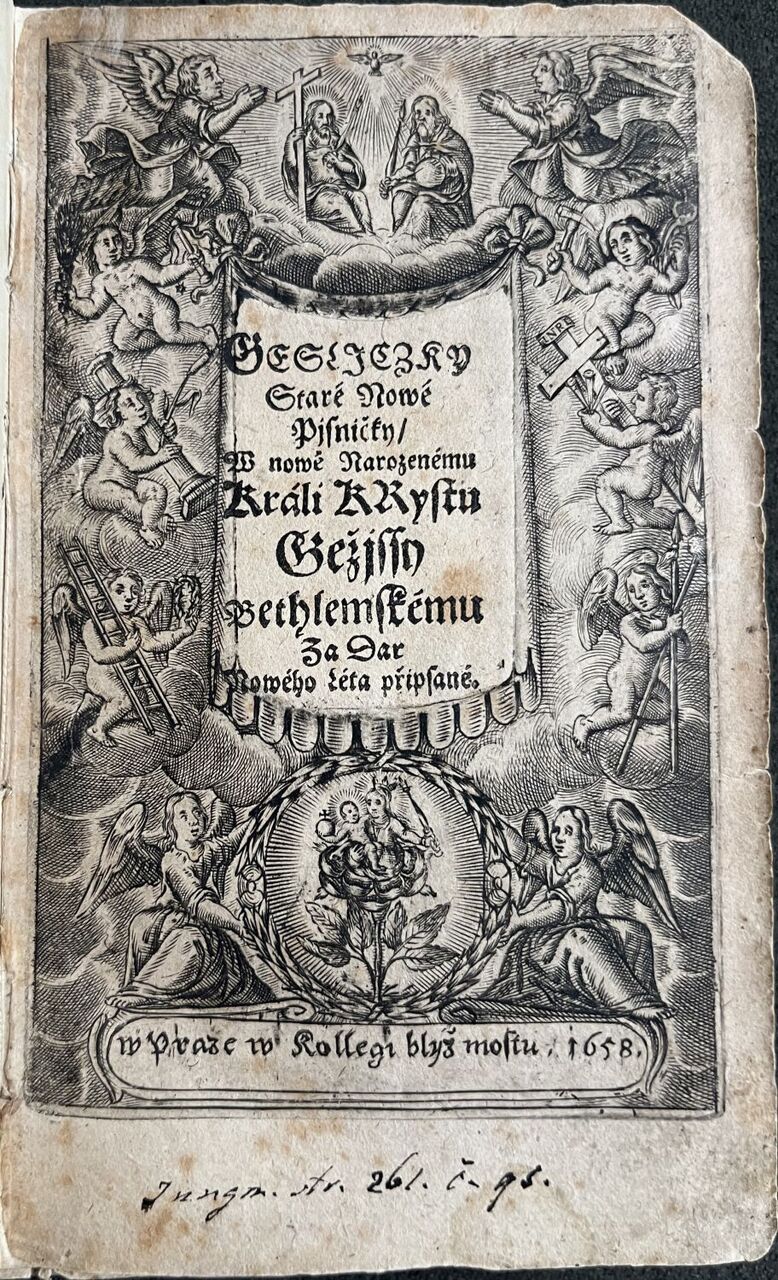
Jesličky staré a nové písničky (“Cribs: Old and New Songs”) by Bedřich Bridel (1656–1660) was printed in 1658, when Bridel himself served as prefect of the Jesuit Printing House. Its title page, framed by a naïve Baroque border, is characteristic of Czech-language output of the period. The book contains more than fifty Christmas songs, ranging from the mediaeval hymn Narodil se Kristus Pán (“Our Lord is born”) … through compositions by Adam Michna of Otradovice to Bridel’s own Slavíček (“The Nightingale”). Some songs are provided with musical notation; others include only the remark “to be sung to a well-known tune.”
NL CR 54 F 113
Balbín: Diva Montis sancti, 1665
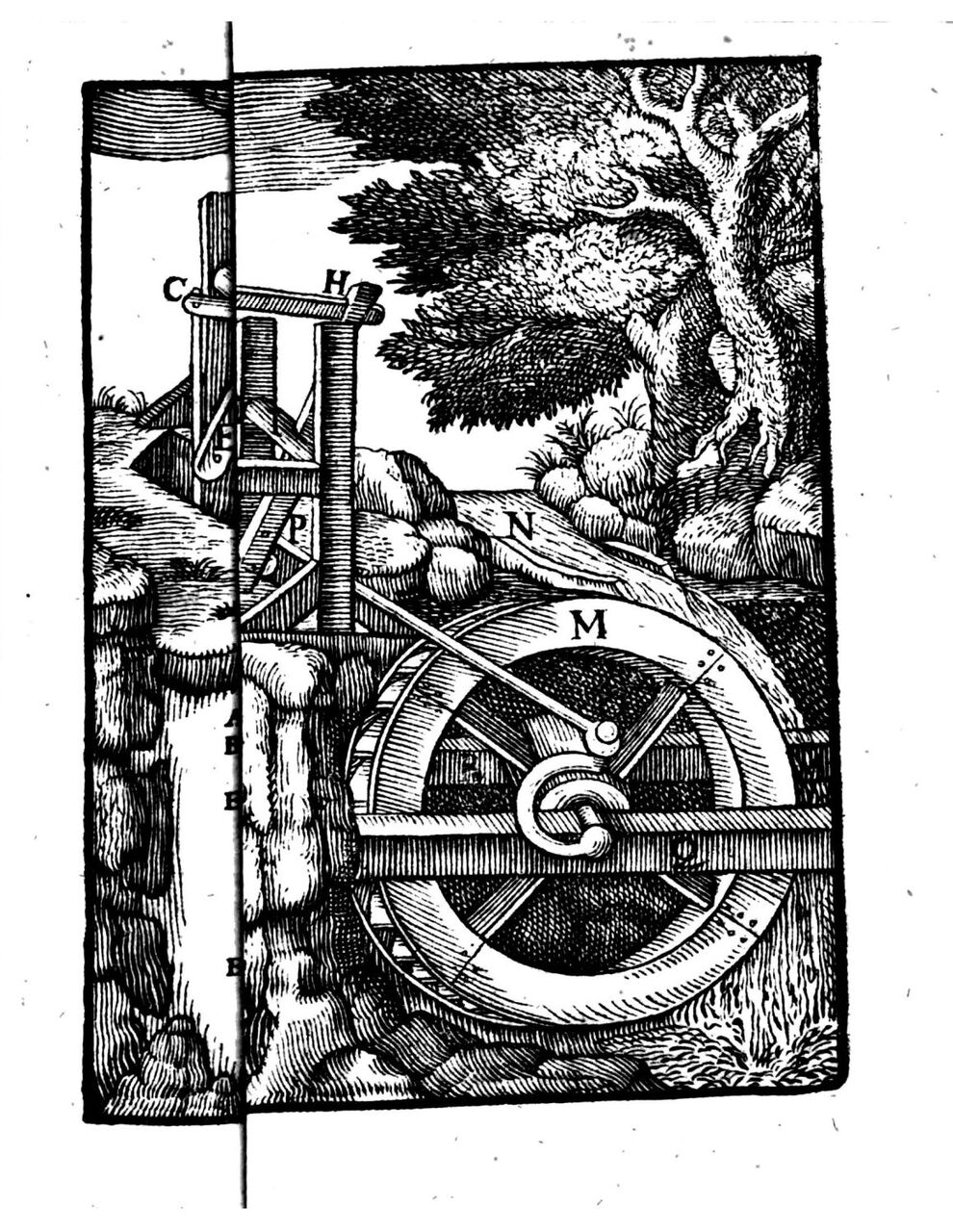
Diva Montis Sancti (“The Lady of the Holy Mountain”) by Bohuslav Balbín (1621–1688), published in 1665, describes not only the miracles of the revered statue of the Virgin Mary at Svatá Hora near Příbram, but also the history and contemporary life of the entire region, as evidenced by the engraved plate depicting the machine used to drain water from the Příbram mines.
NL CR 51 C 44