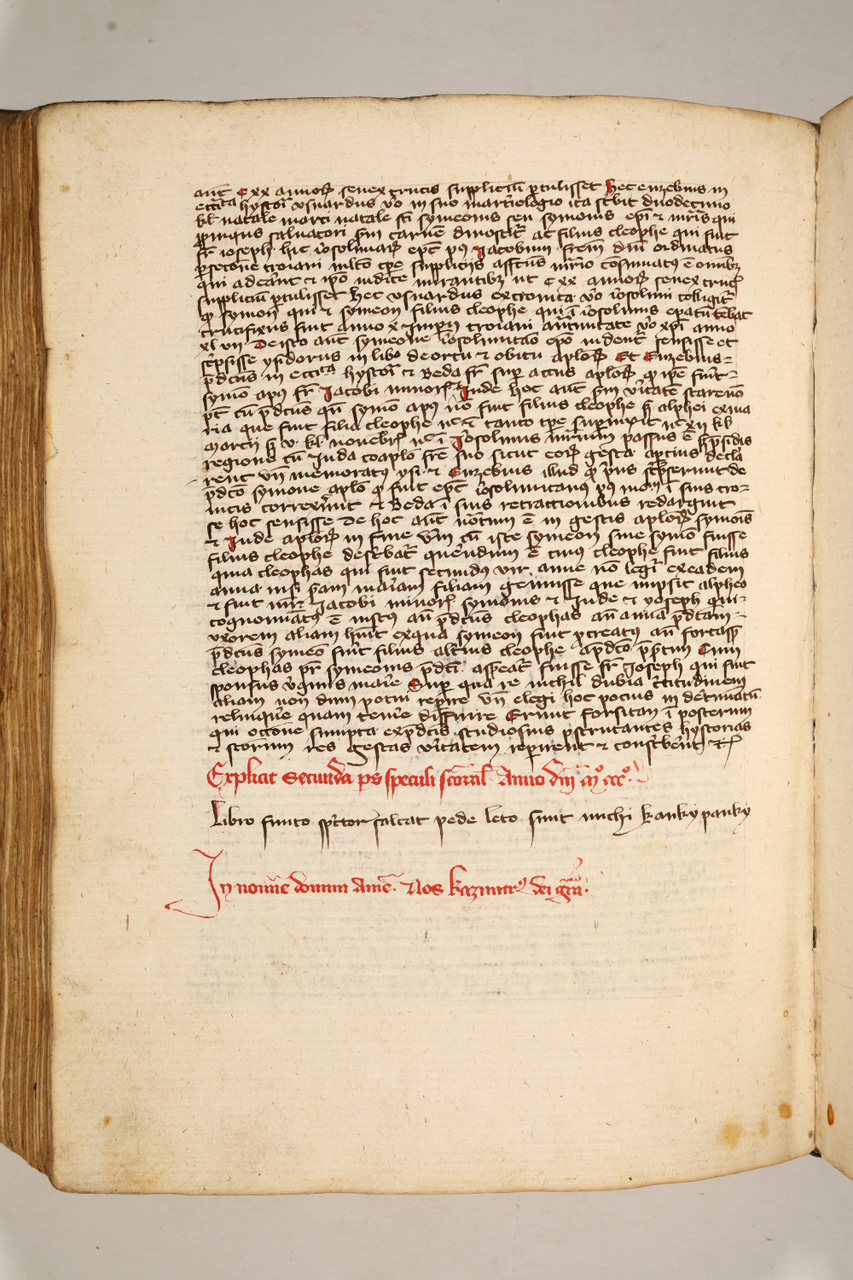
The entire manuscript is copied by a single scribe, who added a remarkable colophon at the end.
Bernard Gui: Speculi sanctoralis pars II.
NL CR, sign. X B 15, fol. 133v
Late 14th century
The manuscript contains the work Speculum sanctorale (“Mirror of the Saints”, i.e., a collection of saints' lives), specifically its second part, which is devoted to John the Baptist, the Evangelists, the Apostles, and selected disciples. The author of this text, which, among other things, served as a source for the sermons of Jan Hus, is the French Dominican and inquisitor Bernard Gui (1261/62–1331).
The entire manuscript is copied by a single scribe, who added a remarkable colophon at the end. Already its first line (in red ink) is striking:
Explicit secunda pars Speculi sanctoralis, anno domini M° CCC°.
“The second part of the Mirror of the Saints ends, in the year of Our Lord 1300.”
Bernard Gui finished the text in the first decades of the 14 century, while the present manuscript comes only from its final third; the scribe therefore merely failed to write out the full year in which he copied the manuscript; at the same time, he gives no indication that the date is to be continued. The following line contains a rhymed formula expressing the scribe's relief at the completion of his work:
Libro finito scriptor saltat pede leto
“When the book is finished, the scribe leaps with joyful step.”
This is followed, however, by an unintelligible sentence:
sunt michi kanky panky.
“Now come my kanky panky.”
Although such an expression is not attested in mediaeval Latin, Czech, or German, it is most likely a wordplay based on phonetic similarity between words differing by only a single letter (cf. modern playful expressions such as “hocus-pocus” or “hurly-burly”; a paronomasia or pun). The word “kanky” might conceivably derive from the German Gang (“gait”, “movement”), and the phrase as a whole could thus evoke motion, the scribe's cheerful dancing or skipping. This, however, remains uncertain, and such nonsensical expressions occur with surprising frequency in mediaeval scribal colophons. The final line, again in red, reads:
In nomine Domini amen, nos Kazimirus, dei gracia…
“In the name of the Lord, Amen. We, Kazimierz, by the grace of God…”
This last sentence resembles the invocation and intitulation of a charter and most likely refers to Kazimierz III the Great (1333–1370). It is, however, difficult to determine its function here: at the very end of the book, the reader expects a conclusion, but is instead presented with a beginning.
All three parts of this colophon thus, in one way or another, disrupt the reader's expectations. On the facing page, one may observe a modern intervention in the medieval manuscript: the watermark has been traced in pencil in order to make it more clearly visible.